

Rural Virginians battle
Big Tech data centers
By Julianna Stephenson and Jordan Hoover
Drone footage above the site of Google's future data center. Video by Julianna Stephenson.
Marlene and Edward Preston sit in their sunroom at night, stargazing, appreciating the quiet that surrounds their home near Greenfield in Botetourt County. In the mornings, they enjoy going on their front porch to breathe in the fresh air.
But now they worry that their peace and quiet will end when Google builds a one-million-square-foot data center complex at the edge of their backyard.
"I think appreciating nature is what we're supposed to do," Edward Preston said. "You can do that here, but it's getting harder to appreciate nature when it's being impacted and it's being disguised."

Marlene and Edward Preston sit on a swing in their sunroom with their dog Teddy. Photo by Jordan Hoover.
Even though Donna Janeczko lives 10 miles away, she wonders what will come next.
Botetourt residents and their elected officials are sometimes at odds over how much development is too much in the county.
Many residents treasure the county's rural character. They love the quiet, the mountain views, and being close to unspoiled nature.
"I love the land," Janeczko said as she started to cry. "And I'm kind of old, so I know that this is the end."
In June 2025, the Botetourt County Board of Supervisors announced that Google purchased 312 acres in the Botetourt Center at Greenfield, an industrial park, according to a performance agreement between Google and the county.
"It's a monster," said Beth Hoover, who lives about a mile away from the land that Google purchased.

Donna Janeczko stands in her backyard. Photo by Jordan Hoover.
Helio Capital LLC, a Google subsidiary, paid $14 million for the land that it plans to develop into a data center complex. The complex will generate at least 150 jobs.
"I felt betrayed," Marlene Preston said. "If you had told me a year ago there was going to be a Google data center, I would have done a lot of research to even know what impact that was going to be."
Botetourt County voters didn't know about the deal until after it was announced. There were no public hearings or notices that specifically addressed the Google project in Greenfield. That's because the land that Google bought had already been zoned for data centers.

In 1995, the county paid $4.5 million for 900 acres of land, known as Blount Farm.
The supervisors then rezoned more than 80% of it–about 750 acres that became the industrial park at Greenfield. Part of it was sold to Google.
In 2014, the county zoned the land as research and advanced manufacturing (RAM), allowing the manufacturing, processing, fabrication, testing or assembly of products.
The zoning designation allows commercial buildings, utility facilities, manufacturing sites, laboratories and more to be built.
The Botetourt Center at Greenfield. Photo by Jordan Hoover.
The Board of Supervisors and Planning Commission also changed the RAM zoning ordinance to include data centers on Nov. 26, 2024, two days before Thanksgiving.

The Google data center will be near Greenfield Elementary School, the Cherry Blossom Trail and the Greenfield Recreation Park. Graphic by Jordan Hoover.
On its website, the county said it advertised the meeting, during which officials voted unanimously to allow a data center to be built. But residents said the meeting was not publicized.
"Well, they didn't advertise a public hearing," said Frank Lucia, who lives 500 feet from the data center site. "Only the adjacent property owners were notified, he said.
Lucia said he received a letter from the county about the meeting only one day before it took place on Nov. 25, 2024. He pulled the letter, dated Nov. 18, 2024, out of a stack of documents he's collected over the past several months.

_edited.png)
They're not a board of a company that's trying to maximize shareholder value. They're a Board of Supervisors representing county residents. And a big part of that is quality of life.
Frank Lucia
Botetourt resident

The Lucia family received a letter from the county about a zoning change related to the property next to them. Source: Frank Lucia.
The letter that adjacent property owners received said there was a meeting about changing a zoning ordinance and didn't mention anything about data centers.
Frank Lucia also said that the county "buried" the data center zoning ordinance change as the last item on the agenda. Only one person expressed concerns during the public comment portion, and he said the process felt rushed.
A public notice was posted publicly on local news sites, Cardinal News and the Fincastle Herald, a few days before the meeting, Frank Lucia said.
"They're not a board of a company that's trying to maximize shareholder value. They're a Board of Supervisors representing county residents," he said. "And a big part of that is quality of life."
Botetourt County Data Center Timeline
Graphic by Julianna Stephenson and Jordan Hoover.
Rural communities like Botetourt are seeing data centers creep down from Northern Virginia. Northern Virginia is the largest data center hub in the world, with 13% of global operations, according to the Joint Legislative Audit and Review Commission.
"To be fair, a data center, you could have a worse neighbor," said Channing Preston, the son of Edward and Marlene, who lives next door. "And the tax benefits, I mean, this area needs it."
The county estimates that Google will pay an estimated $10 million per year in local tax revenue, according to its website. That revenue more than doubles the current top three manufacturers in the county, which pay a total of $4.25 million annually in local taxes.
"When a big company waves a bunch of money in your face, you should probably ask more questions," said Rich Donnelly, who lives about a mile from where the data center will be built. "I think that's where the board has let the citizens down, that they probably didn't ask all the questions that needed to be asked."
The Board of Supervisors told residents in a meeting that they did not visit a comparable data center site, Frank Lucia said.
Marlene Preston said that while Google is giving the county a lot of money, she doesn't think it outweighs the health and peace of the residents living next door.
On its website, Botetourt County says the data center complex will be in a "dedicated business park situated away from neighborhoods." But there are people living in seven homes whose backyards are adjacent to the data center property.


Frank and Leigh Ann Lucia share a 1,100-square-foot property line with Google's land.
The Lucias are worried about the construction process.
"We have zero protections based on the contract that the county has signed. Zero," Frank Lucia said. "They could mess up our foundation. They could ruin our wells."
The county administrator told the Lucias that they would need to contact Google if their property is damaged, Frank Lucia said.
The Lucias have tried asking the county questions, he said.
"They appear to be unwilling to have meaningful conversations at this point," Frank Lucia said.
"Just like simple questions. Are there going to be hours where construction can happen, so we can possibly plan a family event? No answer."
He said he had a conversation with Gary Larrowe, the county administrator, and the representative for their district, Tim Snyder. But he's been ignored ever since.

Save Boutetourt signs line the streets near Greenfield Elementary School. Photo by Jordan Hoover.
Lucia said he first realized that something was happening in 2020 when he noticed red marking ribbons along his property line. The county told him that they were clearing the land to have "shovel-ready sites" because that's what companies wanted.
He asked the county if he could buy more acreage to create more of a buffer, but officials rejected his request. Then, he asked the county to leave the trees along the natural ridge line. He said he even offered to pay the county for the loss of the timber. The county rejected his offer.
The county agreed to create a 200-foot buffer from his property line into Google's land, Frank Lucia said.
"Unfortunately, when they came in, they messed that up," he said.
Some of the trees within the 200-foot buffer were torn down. He said Larrowe admitted that an error had been made.

Backroom deals
Residents didn't know about the data center because several county elected officials and employees signed non-disclosure agreements, according to responses to Freedom of Information Act requests filed by the Rockbridge Report. The officials included the county's administrator, its supervisors and economic development officials, and employees of the Western Virginia Water Authority.
NDAs typically are designed to protect proprietary information that can be revealed in negotiations between private parties.
The Rockbridge Report received 18 NDAs from FOIA requests to the county. Larrowe, the county administrator, signed four NDAs from January 2024 to January 2026. Michael McEvoy, executive director of the Western Virginia Water Authority, also signed an NDA on behalf of the water authority's employees and board of directors on March 11, 2024.
Roanoke City Mayor Joe Cobb said NDAs are critically important in economic development projects. But he said serving constituents should always come first.
"I think it's always a fine line about what you can share about a project and what you can't share," Cobb said. "But I think in the roles that we have as elected officials, it's important to share as much information as we have access to."
Botetourt County Administrator Gary Larrowe's NDA. Source: FOIA request by the Rockbridge Report.
The citizens are not the enemy of the government.
Rich Donnelly
Botetourt resident
All NDAs obtained by the Rockbridge Report can be found here.
Seth Spickard, who grew up in Fincastle, said he didn't know that county officials had signed NDAs until a reporter told him.
"My gut reaction is, yikes," he said. "I think they have some sort of responsibility to then communicate to their constituency, right?"
Donnelly, who lives close to the data center site, said public officials should not keep such big developments from the public.
"I was a career military officer. I had a security clearance," he said. "We kept many things secret from our nation's enemies. The citizens are not the enemy of the government."
Janeczko said she's frustrated. "We find out about things too late," she said. "We can object all we want. Who cares? It's a done deal."
Botetourt resident Austin Schwend said he feels like his trust has been betrayed.
"Out here in rural Virginia, we tend to trust people," he said. "And that starts to work against you because when those people prove they're not trustworthy, it's too late."
Scott McLucas, another Botetourt resident, said he's confident that the Board of Supervisors has done its research.
"As far as I can tell, it seems like it's been pretty transparent," he said. "The supervisors that I know have been open and honest."

Jessie Bearman, who lives about a mile away from the Google data center complex, said she is petitioning the Board of Supervisors to change the times of monthly meetings.
She said the current 2 p.m. meetings on the fourth Tuesday of the month exclude many taxpaying citizens in the county because they're at work.
"They're very lucky to have a highly employed tax base here to which they are not catering to," Bearman said. "They need to have a 6 p.m. meeting to allow those people to have their voices heard."
Shirley Jarusek (left) and Jessie Bearman (right) sit in front of the local Kroger to advertise a meeting about data center concerns. Photo by Jordan Hoover.
At the February 2026 board meeting, about 75 people showed up. Nearly 15 people spoke against the data center during the citizen comment period.
Some residents say they still have hope that they can stop the data center project.
"It may be too late," Janeckzo said. "I hope it's not. I think people can probably fight it in mass. And it looks like the ball is beginning to roll, so I like that."

A member of the Southwest Virginia Data Center Transparency Alliance wears a "No Data Center in Botetourt County" pin.
Photo by Jordan Hoover.
In October 2025, Ben Vershoor and Julie Bivins, both residents of Roanoke City, created a Facebook group for what they call the Southwest Virginia Data Center Transparency Alliance to mobilize people who oppose the Google project.
The Facebook group has more than 1,000 members who share research studies and news about the Botetourt data center. The members include residents of Roanoke and Botetourt.


Ben Vershoor (left) and Julie Bivins (right) are co-founders of the Southwest Virginia Data Center Transparency Alliance. Photos by Jordan Hoover.
"Yes, they have agreed," Vershoor said. "They signed the performance agreement with Google, but it does leave an opening for that contract to be dissolved if Google decides not to build something there."
Bearman has created a petition to push back against the Google data center complex. She is hoping to obtain 5,000 signatures. She had 2,015 as of April 11, 2026.

Water worries
The Western Virginia Water Authority supplies water to residents in Botetourt County, Roanoke City, Roanoke County and Franklin County. The water authority has also agreed to provide 2 million gallons of water per day to the Google data center complex in Botetourt.
Residents across the region are worried that the water authority won't be able to supply enough water to everyone who needs it.
Roanoke City owns the land at Carvins Cove, which is the reservoir that will supply most of the data center's water. That's why Cobb, Roanoke City's mayor, said he originally requested 15% of the data center revenue. He later rescinded his request after reading an agreement between the water authority and Botetourt.

Carvins Cove will be the primary water source for the data center. Photo by Sydney Devory.
The water authority was created in 2004 after two major droughts hit the Roanoke Valley in 1999 and 2002. During the droughts, the city's reservoir, Carvins Cove, dropped to low levels. The city placed its residents on voluntary and, later, mandatory water conservation. But residents in Roanoke County could use as much as they wanted since their reservoir, Spring Hollow, was full.
The Google data center would be the top consumer of the authority's water, and residents worry that there won't be enough for them.
"Our area is blessed with a reasonable amount of water," said Donnelly, who lives near the Google data center site. "Some years we have enough. Some years we have a drought. This will use a lot.”
But the Western Virginia Water Authority and Botetourt County plan to create a new water source, according to an agreement between the two. The agreement does not explain the project's details.
The water authority already realized before the data center deal that it needed another water source by 2060. But the timeline has been pushed up because of the proposed data center and its expected water needs.

Rich Donnelly lives about a mile from the future Google data center. Photo by Jordan Hoover.
Until late February 2026, the water authority refused to release the amount of water that it would provide to the data center. It claimed the data center's water use estimate was "proprietary information."
But Henri Gendreau, the founder of the news outlet the Roanoke Rambler, filed a lawsuit that sought the water usage numbers. Circuit Court Judge Leisa Ciaffone sided with Gendreau and the Rambler. The water authority appealed the decision, and the court gave the water authority more time to release the specifics. The authority then released the estimates before it faced a contempt-of-court hearing.
Google opposed the release of the water estimates. In a document submitted as evidence in the lawsuit, Google Senior Director Aaron McGarry wrote that the information is "confidential, proprietary, and highly sensitive commercial information and trade secrets."
Campbell County residents are also concerned about water.
Resident Sandy Glass, an accounting professor at Lynchburg University, said she's worried about two data centers that are proposed in her area.
She said she is concerned about the possible competition between residents and the data center over water that could occur during a drought.
"The majority of our water comes out of a river that actually hit an all-time low last month and, I think, can only pull 5 to 8 million gallons total per day," she said. "And so, those numbers are really scary."
The U.S. Drought Monitor has labeled Campbell County as a severe drought area. In March, one of the county's water sources, the Big Otter River, dropped to below normal levels.
Glass said she fears the county will choose to supply the data centers to appease Big Tech companies and disregard residents' access to water.

Another county in the dark
Campbell County residents also said they feel like they've been left in the dark.
In July 2025, the county Planning Commission considered a proposal by MESH Capital to build a data center on Cabin Field Road. The county subsequently rezoned the land with a manufacturing designation.
The owner of land on Mount Athos Road wants the county to rezone the property to allow a data center to be built there eventually.
"As of right now we have had some proposals, but we do not have an official data center coming," said Karissa Shrader, the assistant zoning administrator.
Campbell County is slightly larger than Botetourt, with a population of more than 55,000 residents.
Glass, the Lynchburg University professor, has submitted several FOIA requests that tracked the county's discussions with MESH Capital. She's also used FOIA to obtain NDAs that county officials signed, she said.
Supervisor Jon Hardie, who represents the Rustbridge district, said the board hadn't been looped in on the zoning issues regarding potential data centers.
"I have been provided little to no information from county administration or staff about them," he said.
In December, the board passed a temporary ordinance that requires data centers to seek special use permits, which require public hearings. The board has extended the ordinance's timeframe at least twice.
Like Hardie, Matt Cline, the supervisor who represents the Concord district, wants the board to vote to convert the temporary ordinance into a permanent part of the county's zoning code.
The Campbell County Board of Supervisors voted to move forward with the special use permits process on April 14, 2026, but two public hearings must be held before it becomes finalized, Cline said.
The public hearings will be held at the next Planning Commission and Board of Supervisors meeting.
"I'm not for or against data centers," Cline said. "I'm for doing things right. And if we're going to get a data center, we need to have as much say and control over how it's going to impact the community as we possibly can because once it's built, it's there, right? There's nothing we can do about it at that stage. So we need to be in front of it."

A data center success story
Photo by the Associated Press.
In some rural counties like Mecklenburg, data centers have been good for communities.
Mecklenburg County is a similar size to Botetourt, with about 34,000 residents, and has had a data center for more than a decade. Revenue from the site has allowed the county to reconstruct every school building in the area.
In 2010, Microsoft built a data center that became the county's second-largest employer. The Virginia Commonwealth University Health Community Memorial Hospital is the largest employer.
"In Mecklenburg County, sixty-two percent of our business establishments employ between zero and four people," said Alex Gottschalk, the Mecklenburg County administrator.
About 66% of Botetourt County's businesses also employ between zero and four people.
"By the fall of 2030, every single school in this county will have been built in this century," Gottschalk said. "People just don't do that."
The county will spend about $300 million by then to build a new high school, middle school and three elementary schools.
Mecklenburg has had a positive experience with the Microsoft data center because the county lacks big employers that would generate tax revenue, the county administrator said.
But Gottschalk warned other counties to be careful about where data centers are built and to communicate with residents.
"Be very clear about how the data center, or any other industry that's coming in will help you accomplish goals," he said. "I think the community will buy in better if they know what they're getting from a certain development."

Altering the rural landscape
The proposed Google data center complex will be located between Fincastle and Daleville off Route 220. Over the past several years, Daleville has turned into a series of apartment complexes, chain restaurants and gas stations, residents said.
Botetourt residents worry that the data center complex is opening the door for the Board of Supervisors to develop the rest of the county.
"You're going to go in this beautiful rural county, and you are going to monetize every bit of land there by making all these deals for businesses to move in," said Janeczko, who lives about 10 miles away from where Google bought land.
Leigh Ann Lucia's porch is 500 feet from the proposed data center. She said she used to love the county.
"We moved here because it was quiet," she said. "We found this home, and it was a beautiful setting."
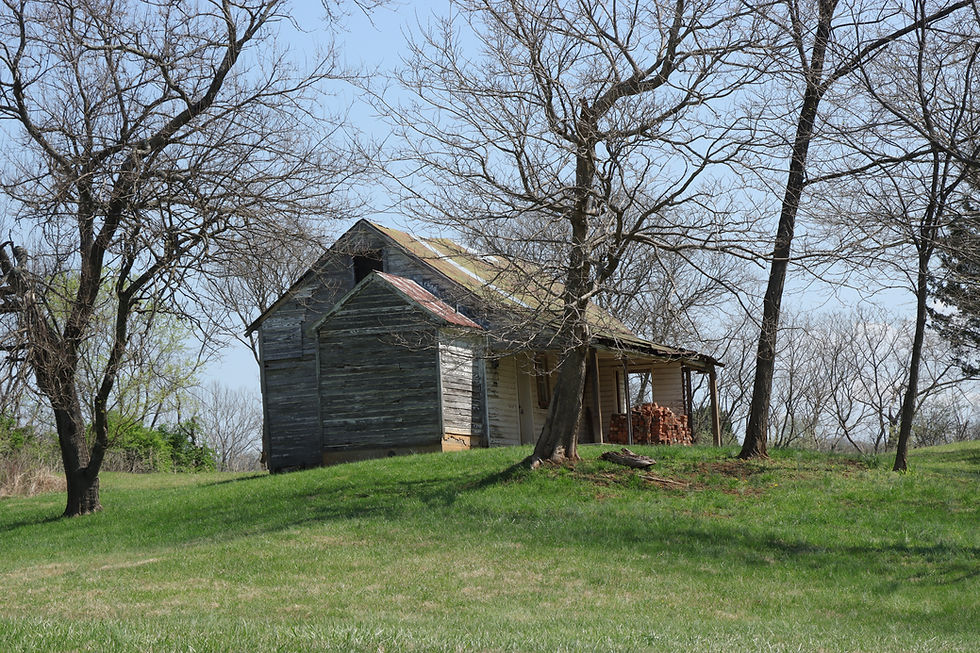
For generations, Edward Preston's ancestors owned the land at Greenfield, where Google's data center will be built.
Col. William Preston owned 2,175 acres at Greenfield beginning in 1759. His descendants owned the property for centuries. The original Greenfield home was destroyed in a fire in 1959. Over 900 acres were then sold to the Blounts, who established Blount Farm in 1965. Botetourt County bought Blount Farm in 1995 and developed it into the industrial park.
Col. Preston's remaining buildings are on a small parcel of land called the Greenfield Preservation Area. Edward Preston is chair of the Historic Greenfield Advisory Council, which advises the county on preserving and restoring Greenfield’s buildings and grounds.
Edward and Marlene Preston own 50 acres. Their son, daughter-in-law and grandchildren live on a few acres across the driveway.
A building that Col. William Preston owned next to the bee sanctuary. Photo by Jordan Hoover
"We see it as kind of the last corner of Greenfield that has Prestons living on the property," Marlene Preston said.
Some residents worry that a data center complex would ruin nature at Greenfield. The Cherry Blossom Trail, a community beehive, the Botetourt Sports Complex and Greenfield Elementary School are all near the proposed complex.
The area is used for outdoor recreation by residents of all ages.
"It's a beautiful haven for cyclists, runners, ornithologists, kids," said Hoover, who lives about a mile away and walks the trail several times each week. "It’s just a beautiful place."


Ducks and geese can be found in the area where people also fish, walk and run, she said.
"It's got the ducklings," Hoover said. "On the pond is mama with about 12 little ones waddling behind her. It's like precious to watch. It's so cute."
Hoover said she won't go to the Cherry Blossom Trail anymore if the data center is built.
Bearman, who lives about two miles away from the data center, said she walks the trails at Greenfield several times a week. She said the data center would impact the amount of time she spends outdoors near the site.
She said she's considered moving.
We don't live in the swamp of Washington, D.C. I mean, we live in western Virginia, and this is not why people moved here.
Jessie Bearman
Botetourt resident

Jessie Bearman near Google's land. Photo by Julianna Stephenson.
Botetourt attracts people who like to hike the county's portion of the Appalachian Trail. Hay Rock Hike is a popular trail that gives hikers a view of Carvins Cove, which will supply most of the data center's water.
"One of my favorite hikes, that's local to us, is right there in Daleville, right around Carvins Cove," said Bivins, who is a co-founder of the data center transparency alliance. "All of that just came to mind like, oh my gosh, what are we doing? This is a big part of where we live."

Hay Rock Hike overlooks Carvins Cove, which will be the primary water source for Google's data center. Photo by Julianna Stephenson.
Bearman said she resents how county officials handled the data center deal.
"There's been no transparency," she said. “We don’t live in the swamp of Washington, D.C. I mean, we live in western Virginia, and this is not why people moved here."
Concerned citizens

Edward Preston
Botetourt resident

Marlene Preston
Botetourt resident

Rich Donnelly
Botetourt resident

Donna Janeczko
Botetourt resident

Jessie Bearman
Botetourt resident

Julie Bivins
Co-founder of the Southwest Virginia Data Center Transparency Alliance
