

How zoning rules caused the data center boom
By Margaret Beimdiek and John Little
Zoned Out
Amazon data centers behind homes in Loudoun Meadows in Loudoun County, Va. Video by John Little.
Loudoun County resident Patrick Coulehan remembers seeing cows and horses grazing near his house when he moved into the Loudoun Meadows neighborhood in 2013.
"Sometimes, the cows would get out and go through our neighborhood," he said.
The farmland is long gone.
"Now, this is what I look at," Coulehan said, pointing at the massive building adjacent to his property that he said blocks the view of the sunrise from his porch.
In 2018, Quail Ridge NCP, LLC, an affiliate of a Denver-based real estate company, automatically received approval to build two data centers near Coulehan's home because of zoning decisions that Loudoun County officials made in 2000 and 2014.
"They shouldn't be where we live, where we go to school, and where we recreate," said Ben Keethler, president of the Loudoun Meadows Homeowners Association.
By-right bypass
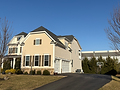
Loudoun Meadows. Photo by John Little.
In Virginia, the law empowers local officials to make changes in zoning ordinances. But they must obtain approval from the General Assembly.
County officials use their power to make rules about what kinds of businesses and residences can be built on different types of land.
But counties that want to make zoning changes must stick within the parameters of their comprehensive plans, which contain the local officials' long-term goals for economic development.
In zoning, there are several ways that land is defined. Counties typically rely on the term "industrial use" to describe data centers. The county administratively allows a proposed project to proceed through what's known as "by-right" if it fits the industrial classification and the minimum building standards.
Under "by-right," the zoning designation provides approval for any proposed project, usually without public hearings.
For 25 years, Loudoun County officials utilized the "by-right" designation to clear the way for data centers to be built in industrial areas and office parks.
In Loudoun, "by-right" circumvented public hearings.
Mike Turner, who was elected to the Loudoun County Board of Supervisors in 2019, said at least one data center has been under construction every day in the county for past 15 years.
The area’s data centers cluster around Route 28, Loudoun County Parkway and Dulles International Airport in the more developed, eastern part of the county.
But around the time of the COVID-19 pandemic, residential backlash started to grow and people began to pack public meetings demanding change as data centers, and the infrastructure which supported them, became larger and more visible.
On March 18, 2025, the Board of Supervisors voted 7 to 2 to eliminate "by-right" for data centers.
As a result, companies must apply for a special exception permit to build a data center anywhere in the county. That means public hearings and a formal vote by the Board of Supervisors.
As of October 2025, Loudoun County has 200 data centers, with over 119 on the way, according to an October 2025 Loudoun County data center report.
Data center cords and chips require power to operate. Photo by John Little.
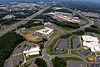
An aerial view of Prince William County. Photo by the Associated Press.
In neighboring Prince William County, residential pushback killed the world's largest proposed data center development, known as "Digital Gateway," because homeowners sued.
In 1998, the county's Board of Supervisors developed a comprehensive plan that sought to preserve rural parts of the area.
Twenty-five years later, the board held a 27-hour hearing, including 19 hours of public comment, as it considered rezoning 1,760 acres of land to allow 37 data centers to be built by developers QTS and Compass.
The board voted 4 to 3 with one abstention to change the land's designation from rural to "planned business district."
The proposed project borders Manassas National Battlefield Park, the site of two Civil War battles.
In 2024, the Oak Valley Homeowners Association filed a lawsuit in Circuit Court to block the rezoning. Judge Kimberly Irving ruled in favor of the homeowners in August 2025, saying the board had failed to properly file timely public notices before the hearing in December 2023.
At issue was that the board missed the first deadline required under state law for an ad to be published in a newspaper two weeks before such a hearing. The board subsequently submitted three ads to the Washington Post that advertised the hearing. But the public could not access the plans, ordinances and amendments until five days before the hearing.
The board and data center developers appealed Irving's decision. On March 31, 2026, a three-judge panel of the Virginia Court of Appeals struck down the rezoning due to the county's failure to comply with state and county public notification laws. The board's clerk had missed the deadline to publish notice of the hearing in the Washington Post, and the county had posted the full text of the proposal nine days too late, according to the ruling.
"The Board simply failed to meet its own self-imposed advertising deadlines," Judge Stuart Raphael wrote in the unanimous decision.
Mac Haddow, president of the Oak Valley Homeowners Association, said the lawsuit and its outcome prove that residents can fight back against massive data center developments.
"We won that battle," Haddow said. "It's truly a David and Goliath situation."
On April 14, 2026, during a closed session, every member of the Board of Supervisors voted to abandon its appeal in the case.
A 27-hour meeting
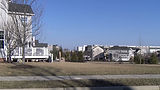
Amazon data centers adjacent to the Loudoun Meadows neighborhood. Video by John Little.
From cows to concrete
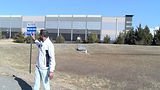
Loudoun Meadows resident Raman Pugalumperumal in front of a data center near his home. Video by John Little.
"We thought we could use the lake, and then we could just go walk down to the farm, see the horses there," he said.
Pugalumperumal said his son used to love waving at the cows from the other side of the fence at the dog park.
"Now, all that is gone," he said.
In 2005, the Loudoun County government rezoned the farmland behind Coulehan’s house, known as Quail Ridge, as an industrial park.
Residents said the Quail Ridge data center campus altered the character of the land when construction began in 2018.
Raman Pugalumperumal, who has lived in Loudoun Meadows since 2013, said his family moved to the neighborhood for the peace it provided.
Google Earth images show how the land behind Quail Ridge has changed since it was rezoned in 2005 for a data center to be built. Images ©2025 Airbus.


County leaders kept the policy going for 25 years because of the money the county received from the data center industry.
In 2008, Turner, a member of the Board of Supervisors, said the county began an aggressive marketing campaign to attract data centers for the tax revenue, touting the county's fast internet processing speed.
Turner said in hindsight he doesn't believe the county made a mistake by allowing data centers to be built under the "by-right" provision.
"They have transformed Loudoun's economy in a way that we really needed as a fast-growing county in the country," he said. "I think the data centers, for the most part, in Loudoun County are in the right place."
In Loudoun County, "by-right" data center policy traces back to a February 2000 memorandum by County Administrator Melinda Artman to the director of Economic Development, in which she said data centers were similar to offices. She said data centers should be permitted wherever offices were allowed.
Two Amazon data centers were built in an area zoned as an industrial park next to a neighborhood. Video by John Little.

Data Center Alley
In the 1960s and 1970s, the Pentagon and research institutions collaborated to establish an electronic communication system.
In the late 1990s, the U.S. Advanced Research Project installed fiber optic cables that eventually put Loudoun County in position to provide one of the fastest connections to the internet in the world.
By 1996, America Online set up its headquarters in Loudoun County. Two years later, the tech company Equinix set up its first data center in Northern Virginia, according to a 2024 General Assembly review on data centers.
Roughly at the same time, Loudoun County developed millions of square feet for office park use to support internet providers AOL and UUNet Technologies Inc.
The office parks were ideal for the data centers of the early 2000s. Back then, data centers typically ranged between 50,000 to 300,000 square feet in size, according to a 2000 memo by Larry Rosentrauch, Loudoun's economic development director.
When the housing market collapsed in 2008, the county's property tax base fell with it. County officials saw data centers as a way to close the revenue gap. Data centers got bigger in the 2010s because of cloud computing.
_HEIC.png)
An Amazon data center behind a home in Loudoun. Photo by John Little.
"Data centers grew up in industrial areas, kind of where we wanted them," said Turner, a county supervisor. "We kind of knew where they were going. And they used up all that land."
That's when data centers started being built near residential neighborhoods. Data center developers took advantage of a change in the county's zoning that was made in 2003 and expanded in 2014 that allowed facilities to be built near homes "by right" without public hearings.
In 2019, the county began revising its Comprehensive Plan. During the feedback process, about 3,000 residents expressed their concerns during 17 public meetings and on a county website.
The result was a new data center strategy that recommended more stringent standards, especially when the facilities were built near residential areas.
In 2023, residents' complaints got louder, and the Board of Supervisors overhauled the county zoning code for the first time in 30 years. The updated ordinance included stricter standards for data centers and required that they be built at least 200 feet from residences.
In March 2024, the Board of Supervisors rejected a 2.9 million-square-foot data center proposed by SDC Capital Partners in Ashburn.
A month later, the board approved a smaller version at 1.3 million square feet, according to the county's website.

Heading south
Progress Park in Wythe County, Va. Photo by John Little.
Tech companies want to build AI data centers in rural parts of Virginia because of access to cheap land and power.
But many people in rural Virginia don't want their communities to become congested with data centers like Loudoun County.
In rural Wythe County, residents have banded together to oppose an incoming data center being built by Solis Arx.
"I don't know that I've ever seen our county so unified on one issue," resident Hannah Ainsworth said. "There seems to be generally bipartisan, nonpartisan support for not having these centers in our areas."
Resident Andy Kegley said people didn't know about the data center until after the Board of Supervisors had approved it.
The entrance to Progress Park. Photo by John Little.
On Dec. 9, 2025, the Wythe County Board of Supervisors announced in a Facebook post that a data center proposed by Solis Arx will be built in an industrial park called Progress Park.
"The reason they made the announcement was a couple days prior, a local contractor ... was driving through the industrial park and saw bulldozers and stopped and asked one of the guys doing the bulldozing what was going on and was told it was a data center," said Kegley, who was a member of the Board of Supervisors in the 1990s.
Residents began to look back at the board's meeting minutes and realized that the plan, operating under the name "Project Gradient," had been discussed in closed, secret sessions.
On May 27, 2025, the supervisors went into a closed session before returning to the meeting room to announce in public that they had approved an agreement between the county's Joint Industrial Development Authority and "the company associated with Project Gradient."

Shortly after the meeting, community members banded together and formed a Facebook group called Preserve Wythe to oppose the project. Resident Donna Nichter said the online group has nearly 400 members.
She said they divided into three groups: one that focused on environmental impacts, another that monitored Board of Supervisors' meetings, and the third group that researched land use ordinances.
Kegley said the group has also started connecting with resistance groups on Facebook, like the Southwest Virginia Data Center Transparency Alliance, and others that are protesting against the incoming Google data center in Botetourt.
The Solis Arx data center was approved without public input because Wythe County does not have a codified zoning ordinance.
The towns of Wytheville and Rural Retreat in the county have zoning rules. But Progress Park is in the part of the county that does not have zoning regulations.
In 1999, Wythe County bought Progress Park to attract industry, according to the county's website.
Wythe County sold the 99-acre park–with an estimated value of $2.5 million–to Solis Arx for $1.
David Manley, director of the county's Joint Industrial Development Authority, said the site location was ideal because it is a mile away from homes but close to an Appalachian Power substation.
"Truly, it's across the road," he said. "The park has feeds of electricity–four independent feeds from four different directions that come into the park, meaning high reliability, high availability."

Kept in the dark
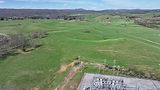
An Appalachian Power substation is across the road from the Solis Arx site. Drone footage by John Little.
Manley also said the project will bring a $1 billion capital investment into Wythe, which the county will be able to collect taxes on.
"That billion-dollar investment would likely yield no less than ten, but upwards of maybe thirteen million annually," he said.
Manley said the tax revenue would nearly double the county's annual receipts.
Charlie Payne, a Fredericksburg lawyer who specializes in zoning and land use, said the $1 plot of land reflects a broader economic trade-off.
"The county already owns the land. And so to them, it's sort of a nominal trade-off because now they get tax dollars from it," he said. "Right now they're generating zero tax dollars from that land because they own it. So it's tax exempt."
Solis Arx still has to meet benchmark standards as outlined in a performance agreement between the company and the county. The agreement sets expectations for the company and protects the county if the project fails to deliver. If Solis Arx cannot meet the standards by the deadline, Wythe County gets the land back.
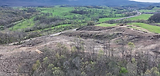
The Solis Arx site in mid-April 2026. Photo by John Little.
Kegley said residents filed requests under the state's Freedom of Information Act and found out that the project is stalled.
Residents discovered that the county engineer issued a stop work order in mid-March because Solis Arx failed to obtain permits from the Department of Environmental Quality to clear the land. The residents also learned that Solis Arx submitted a streamlined plan for permits after the company had already removed trees and cleared the land.
"What we found out is they needed at least a local permit, an erosion and sediment control permit for any land disturbance more than 10,000 square feet," Kegley said. "It was pretty obvious that there was more than 10,000 feet of disturbance going on."

Residents push back
But Kegley said the local government has not addressed the stop work order with the public.
Residents said they hope that Solis Arx won't be able to meet the benchmarks outlined in the performance agreement in time.
"It just feels like slowing it down is going to help hopefully slow it down even more, if not cancel it," Kegley said
Community members have been attending Board of Supervisors' meetings since the data center was announced last year.
"We need people being aware of what is going on," said Ainsworth, a county resident.
Ainsworth said there are grassroots efforts to introduce legislation banning elected officials from signing blanket non-disclosure agreements.
"We understand the need for an NDA when it's like proprietary information and there's a very specific piece of info," she said. "But I do not think NDAs should ever be used as a means of just completely obscuring the information around something that has the potential to create long-term effects and potential harms to an area."
Tech companies typically require local officials to sign NDAs when they enter into agreements with counties.
"I think, unfortunately, they didn't have all the information that maybe would have helped them come to a different conclusion," Ainsworth said.
Kegley said regulations about NDAs need to be included in state FOIA law. "We want to find a legislator who will help us somehow put a limit on NDA use practice because it's clearly contradictory in a democratic government," he said.
Wythe is in the process of creating zoning regulations. The supervisors are holding public meetings as they develop a code.
A draft plan under consideration would allow data centers to be built in industrial parks "by-right." But Kegley said residents are pushing for the Board of Supervisors to require data centers to obtain a special use permit, which requires a public hearing.
Still, residents said they believe zoning will be beneficial because a code can provide greater transparency for future data center projects.
"If we can get community opposition to stand behind adopting a zoning ordinance," Kegley said, "that will at least give an opportunity for a public hearing that we don't have today on projects like that."